
Nosterfield Bird Review January 2026
by Andrew (Andy) M Hanby

The New Year Dawns David Saunders
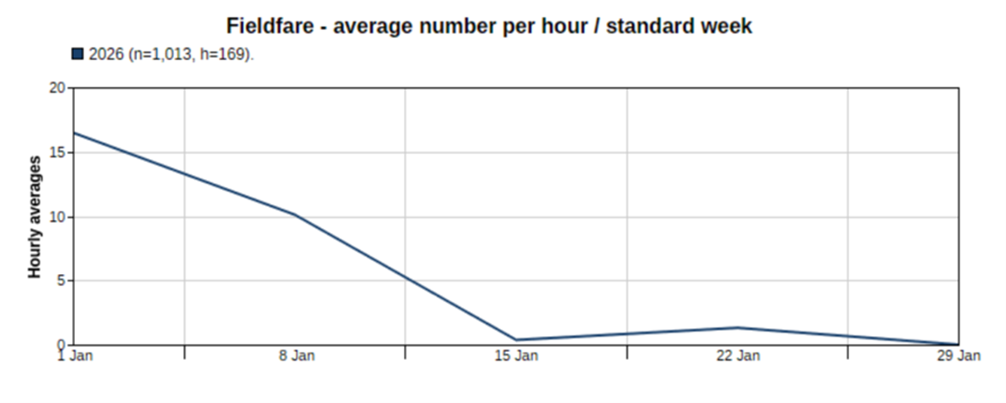
A Woodcock on New Year’s Day provided a nice start to the birding year to one of the few observers out that day. The following day saw more observer activity, with Barn and Little Owls on station and a peak count of 317 Fieldfare in the recording area in the relatively colder weather. It was interesting to see the latter species decline in numbers during the month as things got slightly milder and much wetter.
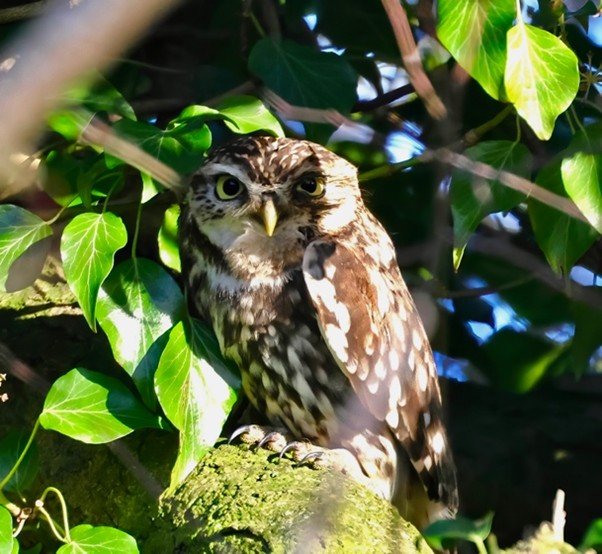
Little Owl Steven Meredith
The first record of Eurasian (Russian) White-fronted Goose occurred on 3rd, with this species being seen on four other dates during the month. Normally a scarce species in the area and as we will see (see February), this year is exceptional.
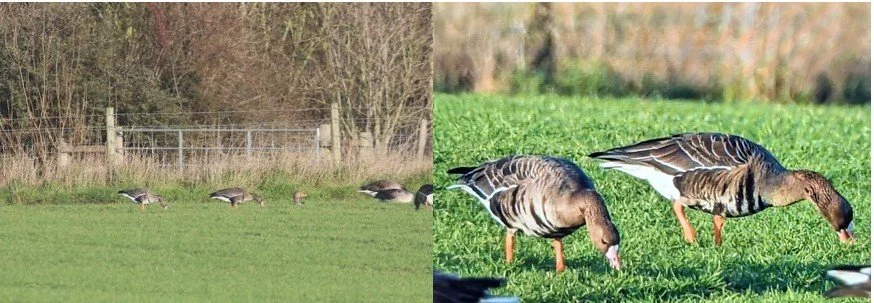
Eurasian White-fronted Geese in a field by Ladybridge Andy Hanby (L) and Nathan Beer (R)
On 4th was the first documentation of Great White Egret for the year. This species has shown a dramatic rise in records - the whole of January generated 24 bird days, with a maximum of three on any one day. To put this in context, there were only seven records in all of 2021 and in the early 1980s, I travelled from Southampton to mid Wales to see my first UK sighting!
The next day, a Green Sandpiper was located and last year’s Scaup was noted to be still present on Lingham Lake (last reported on 12th). A Chiffchaff was also found, another species whose status has changed from migrant to migrant and resident, with possibly as many as three elusive individuals present during the winter.
In early January there is often a pre-migration move of some of the Pink-footed Goose population from east to west. This year was no exception, with 667 moving north on 8th, followed by 378 the next day.
The next few days saw several ‘firsts for the year’, including Dipper and up to five Tree Sparrows. The latter species has shown a considerable decline in the area over the last decade, so it is always good to see that these ‘old friends’ are still with us.
The 12th saw three good candidates for Goshawk chasing over the Reedbed before heading off north. The good spell continued into the next day, with our first Brent Goose for some while appearing on Langwith Lake. This bird had previously been seen at a nearby wetland to the north and its visit to us was very welcome. Four Whooper Swans were also noted on nearby Ladybridge Lake.
For the first week of January Skylarks were noticeably scarce, particularly in the region of the Henges where only one could be found - vastly outnumbered by dogs on and off their leads. Whilst the canines are likely having an impact on the breeding numbers, especially around the South Henge, it is more likely that the winter scarcity relates to movement away from the cold weather at the start of the year. By 14th however, a count of 27 was made, demonstrating numbers reverting to normality.
Another goose that cannot always be relied on to visit the area, in the form of a Tundra Bean Goose, was found late on 16th in a field by Ladybridge Lake and and reported to have been heard, but not seen again, on 18th.
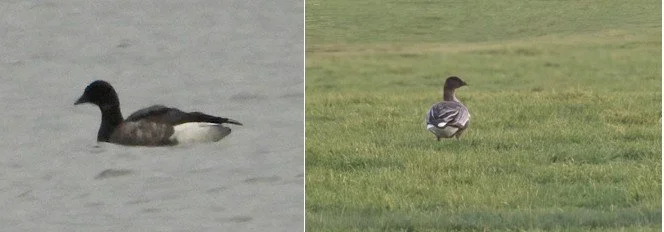
Brent Goose and Tundra Bean Goose Tim Jones and Christine Weaver
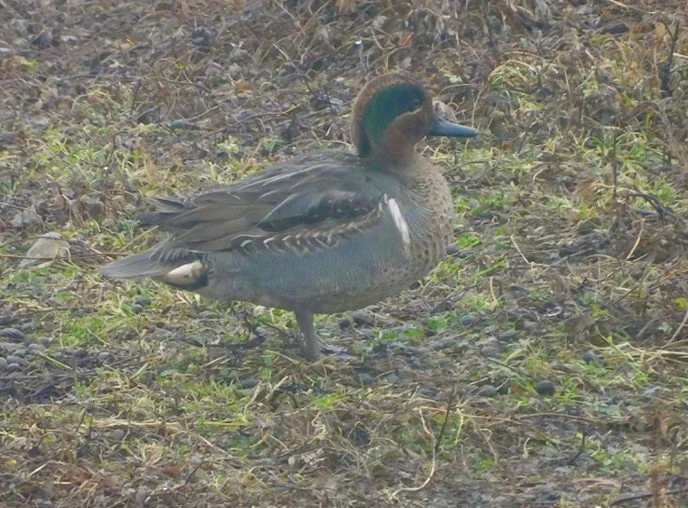
On 19th, a Green-winged Teal graced the Reserve in extremely foggy conditions, but sadly only seen by a select few before cropping up again on Kiln Lake on 26th.
Green-winged Teal Tim Jones
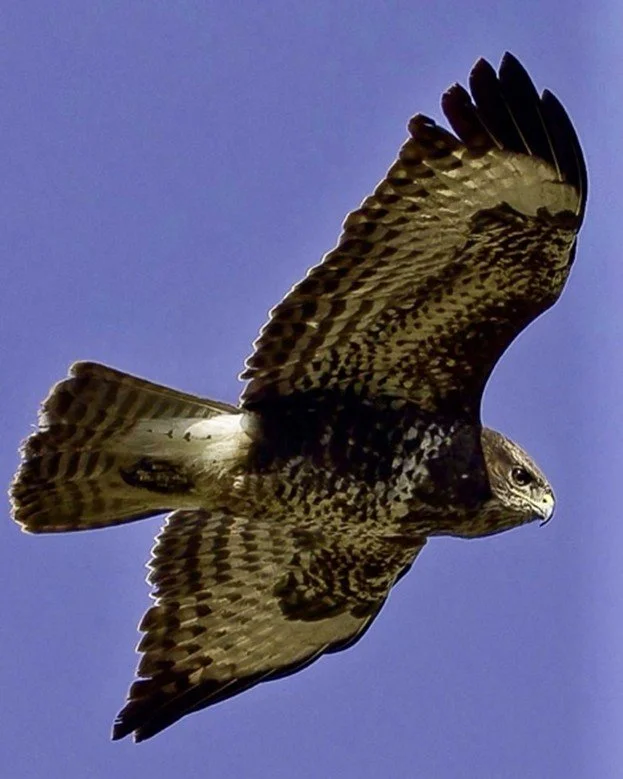
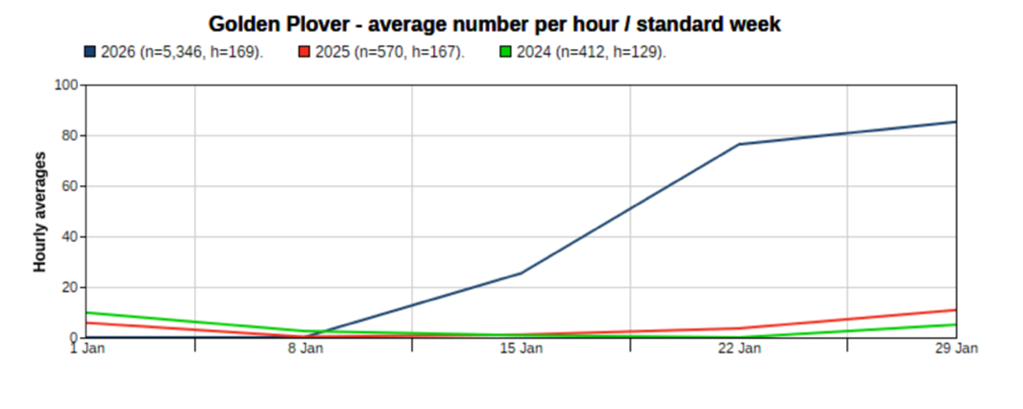
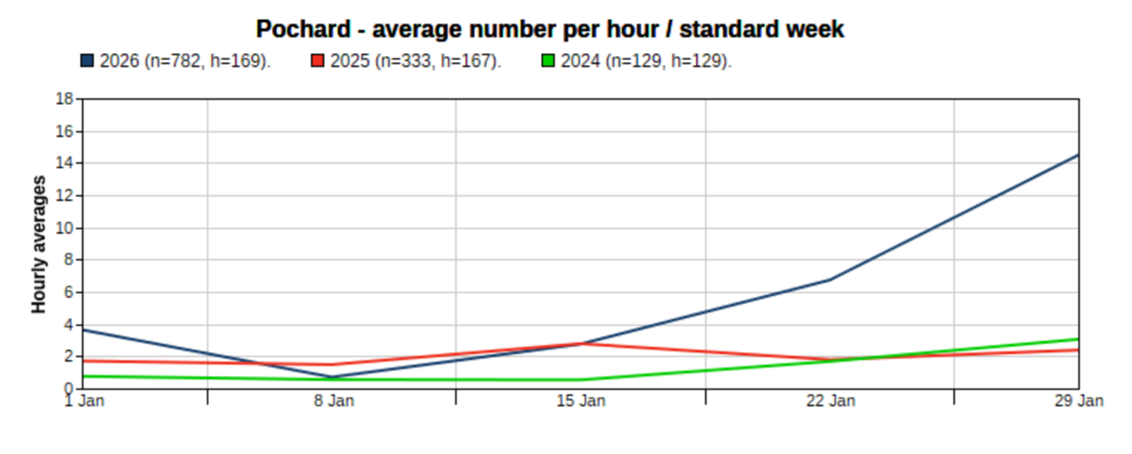
Our first spring migrant, an adult Lesser Black-backed Gull appeared on 20th and was seen a couple more times over the next two days. From 20th to 24th was a good period for big counts, including five Red Kites and 28 Long-tailed Tits on 20th, 86 Pochard on 21st, 3147 Lapwing on 23rd, 576 Golden Plover, 17 Common Buzzard and 24 Great Black-backed Gulls moving south on 24th.
Common Buzzard Steven Farrington
It is some while since we have had such good numbers of Golden Plover in the area - a species that was generally much more abundant locally in the first decade of this century.
The Pochard count kept rising and by 30th had reached 125. In recent years this species has been scarce, with only a handful to be seen. One of the explanations might be the prolonged period of aesterly winds and freezing conditions on the continent. The pits at Bolton-on-Swale to the north of us have also seen impressive numbers, with recent counts of over 400. Another migrant, Ringed Plover also appeared on 30th, injecting an additional scintilla of enthusiasm into the efforts of the regular observers.
It is strange how often the month ends with an avian fanfare. This January was no exception. Unaware that there had been an influx of Shags at nearby Castle Howard, one fortunate observer had two adults pop up in front of him on Kiln Lake. The day was augmented by four Whooper Swans flying north, sinensis Cormorant, Marsh Harrier, 65 Siskin, and the month’s peak count of Golden Plover – 850.
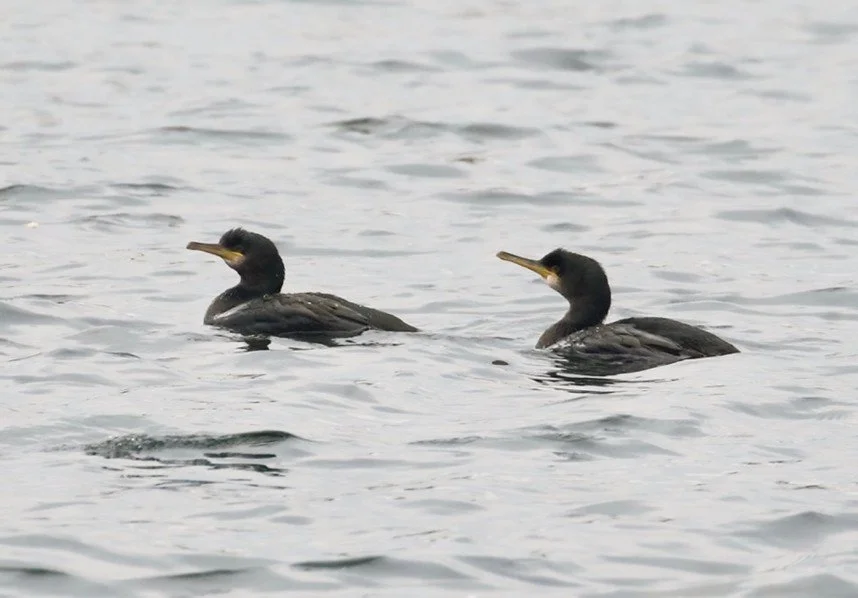
Shag Andy Hanby