
Written by Charles Fletcher
There was a lot of activity amongst the moth trapping team in 2025, and there is much to report this year. Most effort was focussed on the quarry area again, but there were a lot of records of leaf-mining species, and some interesting casual records of day-flying species across the reserve. Out of 328 species recorded during the year, a surprising 23 were new for Nosterfield. The total list has now gone through the 700 “barrier” and stands at 703. This is a highly respectable total for any nature reserve.
Firstly, let us look at the 23 new species. These are a mixture of undiscovered residents, those moving north because of climatic factors, and most excitingly, a handful of species which seem to have been attracted because of habitat creation.
4.012 Stigmella aceris: this moth makes gallery mines on field maple and Norway maple, often with green coiled frass. It was first recorded in Yorkshire in 2021 and has spread dramatically across the county this year, with records in more new hectads than any other species in 2025. A single mine was found on field maple in the hedge opposite Camp Wood on 23rd October.
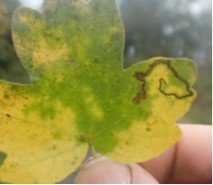
Stigmella aceris
4.039 Stigmella trimaculella: another species forming gallery mines, this time on black poplar. We do not have a lot of black poplar on the reserve, and the trees near the silt lagoons are difficult to access. Mines however were found on fallen leaves on 23rd October, forming small green “islands”.
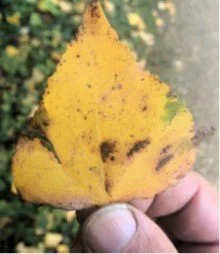
Stigmella trimaculella
4.078 Fomoria septembrella: this species mines the leaves of Hypericum sp. (St John’s-worts) – a thin gallery leading to a round blotch. Mines were found near Kiln Lake on 3rd October.
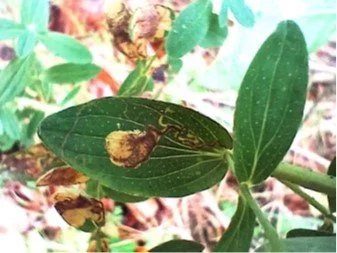
Fomoria septembrella
10.001 Tischeria ekebladella: this fairly common species mines leaves of oak and sweet chestnut, forming blotches reminiscent of a fried egg! Mines were found on oaks bordering on to the reed bed on 19th September.
15.025 Parornix betulae: another fairly common species which mines birch leaves, folding over the edge of the leaf. Mines were found near the silt lagoons on 23rd October.
15.076 Phyllonorycter emberizaepenella: this moth forms underside blister mines/leaf folds on snowberry and sometimes honeysuckle. Tenanted mines were found on snowberry on 23rd October.
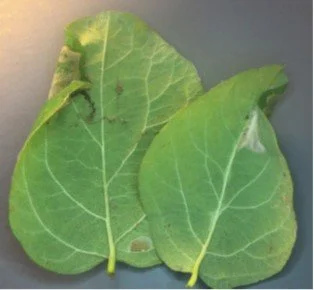
Phyllonorycter emberizaepenella
15.081 Phyllonorycter nicellii: it is surprising that this common species has not been seen before at Nosterfield. Typical tentiform underside mines were found on hazel on the main reserve on 23rd October.
35.118 Scrobipalpa ocellatella: Beet Moth: this was formerly a maritime species of the south of England feeding on sea kale. An influx into Yorkshire in 2022 was thought to be feeding on commercial beet. This was dwarfed by a huge invasion all across the county in 2025 of what could have been either continental or home-grown moths. An amazing 51 were trapped in the Flasks fen area on 12th August.
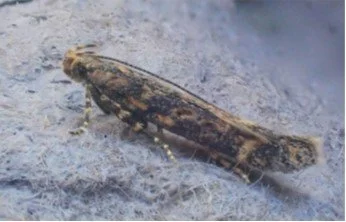
Scrobipalpa ocellatella
37.030 Coleophora binderella: this rare moth forms larval cases on alder. One came to light on 26th June and was dissected to confirm the identity. This was only the second record for VC65.
45.021 Stenoptilia zophodactylus: this little plume moth is uncommon in Yorkshire. The larvae feed on common centaury or yellow-wort, both of which are common plants in the Flasks area. One came to light on 26th June, the first for VC65 and for the Harrogate District. A second turned up at Ellington Banks MOD soon afterwards. The white “saddle” distinguished it from similar species.
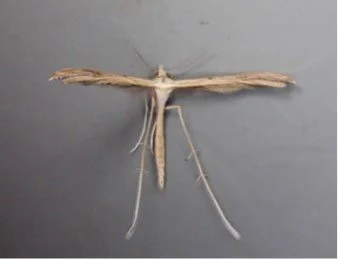
Stenoptilia zophodactylus
49.101 Phalonidia manniana: this is a rather local moth, the larvae feeding on water mint and gypsywort. Two were trapped in the Flasks Fen area on 30th June, one being dissected to exclude P. udana which may lurk undetected in the county.
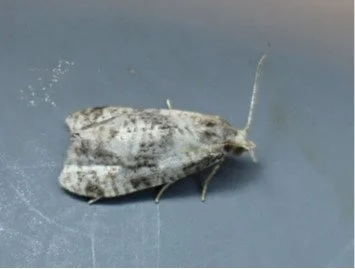
Phalonidia manniana
49.136 Neocochylis hybridella: larvae of this species feed on the flowers and unripe seeds of bristly oxtongue, hawkweed oxtongue and hawk's-beards. One was trapped near the polytunnel, where there is plenty of bristly oxtongue. It has been gradually spreading north-west, and this is the first for VC65.
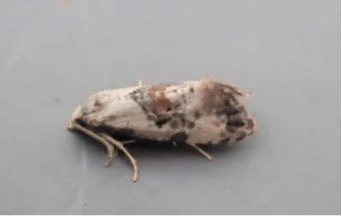
Neocochylis hybridella
49.364 Pammene suspectana: this used to be considered an extremely rare species. It was first found in the UK in 1975, and the first Yorkshire record was not until 2017. The use of pheromone lures has shown that it is not as rare as we thought, and it can turn up at various lures. One was attracted to a Pammene argyrana lure on 2nd May. Larvae probably feed under the bark of ash.
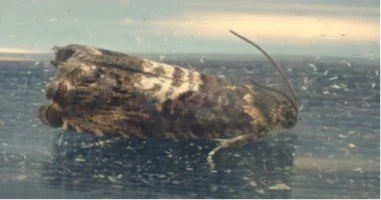
Pammene suspectana
62.055 Homoeosoma nebulella: this is a rather local species in Yorkshire, and very easy to misidentify, as it is extremely similar to several Phycitodes species. One was trapped on 12th August and dissected to confirm the identity. The larvae usually feed in the flower heads and seeds of ragwort or spear thistle.
65.010 Tethea ocularis Figure of Eighty: it is surprising that we have not logged this moth before, as it is fairly common across the county wherever aspen and other poplars grow. There is certainly plenty of aspen in the polytunnel area, where one was trapped on 19th June.
70.104 Lampropteryx otregiata Devon Carpet: this species spread from the south-west of England; the first Yorkshire records being in 2009. Since then, it has become fairly common in the northern half of the county. It is typically a moth of damp open woodland where the larvae feed on marsh bedstraw or fen bedstraw. One was trapped on 12th August.
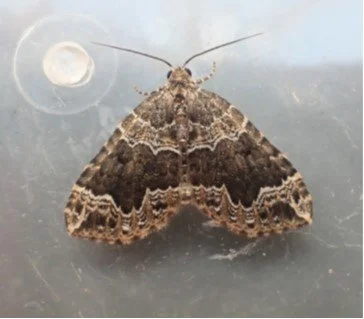
Lampropteryx otregiata Devon Carpet
71.007 Furcula bifida Poplar Kitten: this is much less common than the shorter-winged Sallow Kitten. One was trapped on 1st May. Larvae feed on poplars, including aspen, so it is surprising this is the first time it has occurred at Nosterfield, as we have plenty of aspen in the polytunnel area.
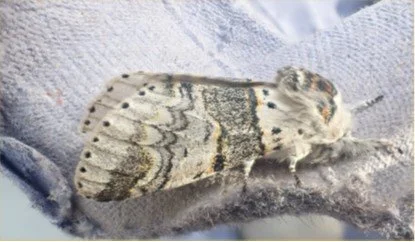
Furcula bifida Poplar Kitten
71.011 Drymonia ruficornis Lunar Marbled Brown: a total of four were trapped on 30th April and 1st May in the polytunnel area. This rather local species is commonest in old oak woodland.
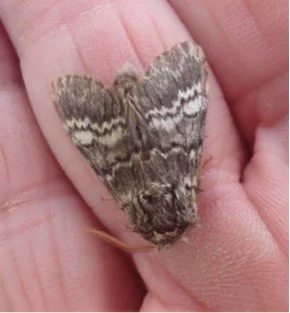
Drymonia ruficornis Lunar Marbled Brown
71.027 Clostera curtula Chocolate-tip: moths were trapped in the polytunnel area on 1st May and 12th August. This is a double-brooded species, hence the wide separation of these dates. This is a relatively new arrival in Yorkshire and has been slowly spreading north and west, so we have been expecting it to arrive. Larvae feed on poplars (including aspen) and willows, so it is just the sort of species we ought to be attracting.
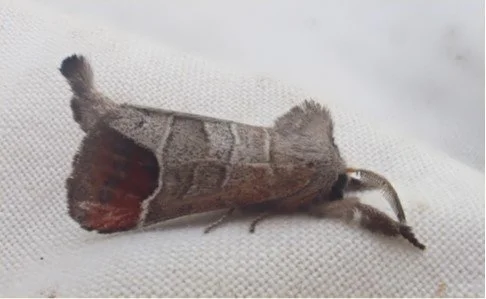
Clostera curtula Chocolate-tip
72.029 Callimorpha dominula Scarlet Tiger: this fairly new arrival to the county has had a remarkable year and expanded its range considerably. One was seen on the evening of 8th July near the main hide. It is often seen flying by day, but also comes to light. Larvae will feed on a variety of plants, but have a particular liking for comfrey, and green alkanet.
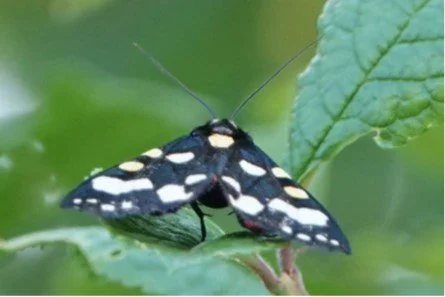
Callimorpha dominula Scarlet Tiger
73.039 Acronicta aceris Sycamore: this is another species which is gradually increasing its range across the county since the 1990s, so we have been expecting it to occur sooner or later. One was trapped in the polytunnel area on 30th June. Larvae, as the name suggests, feed on sycamore and field maple, but in gardens can often be found on horse-chestnut. We must keep a look out for the rather spectacular larva.
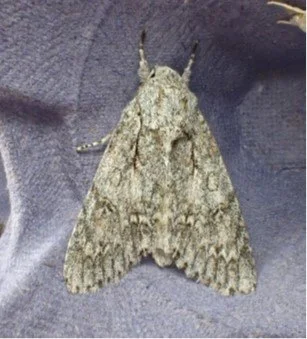
Acronicta aceris Sycamore
73.107 Mormo maura Old Lady: it is surprising that this fairly common species has not been seen at Nosterfield before, but it is not strongly attracted to light. Larvae feed on a variety of herbaceous and woody plants, and can be found in many different habitats. One was found on 1st July by day on the reed bed screen, and one was attracted to light near the polytunnel on 12th August.
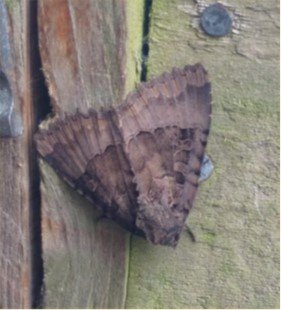
Mormo maura Old Lady
In addition to these new species, there were several other highlights which are worth documenting:
45.043 Adaina microdactyla Hemp Agrimony Plume: just the second record of this tiny plume was trapped on 26th June. We are growing plenty of hemp agrimony so we should see more in the future.
49.092 Phtheochroa inopiana: larvae of this moth are meant to feed on fleabane, but it occurs in some areas with no fleabane, so alternative food plants must be used at times. One on 30th June is our second record; the first being in the reed bed in 2015. The nearest known population is 50 kilometres away.
50.002 Zeuzera pyrina Leopard Moth: we occasionally see single examples of this spectacular moth, but a remarkable five came to light on 30th July.
63.077 Chilo phragmitella: this reed feeding species is doing well at Nosterfield. An extraordinary 16 were trapped on 30th June. This is by far the highest count ever recorded in Yorkshire.
63.079 Calamotropha paludella: larvae of this moth feed on reedmace. Large counts of 27 on 12th August and 23 on 30th June.
63.118 Nymphula nitidulata Beautiful China-mark: this species was new to Nosterfield in 2024. This year four were trapped on three dates between July and August, so it is evidently becoming established. The larvae are aquatic and feed on bur-reeds and yellow water-lily
63.120 Schoenobius gigantella: this is another species which is spreading across the county; our first record coming in 2024. Larvae feed on common reed and reed sweet-grass. On 30th July, 20 were trapped at light. This is the highest ever count in Yorkshire. We have seen unusual counts like this before with other species when they move into an area and before their parasitoid predators catch up with them. It happened when Obscure Wainscot arrived, then numbers dropped dramatically. It is still present but now occurs in ones and twos. Nature’s way of keeping numbers under control is fascinating!
63.121 Donacaula forficella: this is another species which was new for Nosterfield in 2024. One was trapped on 30th June. The larvae feed on a variety of wetland plants.
66.002 Trichiura crataegi Pale Eggar: a declining moth in the county, probably exacerbated by hedge flailing which destroys its over-wintering eggs on hawthorn and blackthorn. An encouraging three were trapped on 12th August.
70.119 Philereme transversata Dark Umber: a local moth in Yorkshire which takes advantage of our buckthorn bushes. One on 30th June.
70.198 Lobophora halterata Seraphim: a local moth, the larvae feeding on aspen. A count of ten on 30th April was unusually high.
71.003 Cerura vinula Puss Moth: a pair of these large and attractive moths were found “in cop” by day on 25th April.
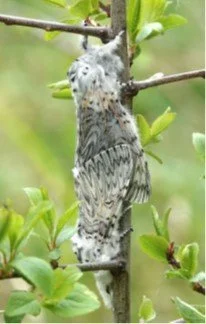
Cerura vinula Puss Moth
72.026 Arctia caja Garden Tiger: numbers of this attractive moth are declining, so it is nice to report that it still occurs at Nosterfield, with one on 26th June and two on 30th June.
73.058 Cucullia verbasci Mullein: the large and spectacular larvae are often seen on mullein and figwort, but the rather attractive adult is not often seen. One was trapped on 24th April.
73.100 Chilodes maritima Silky Wainscot: this reed-feeding moth is doing well at Nosterfield. 34 trapped on 30th June is the second highest ever count in Yorkshire.
73.139 Lenisa geminipuncta Twin-spotted Wainscot: another species dependent on common reed. It is usually only seen in small numbers, so four on 12th August was a good count.
73.142 Coenobia rufa Small Rufous: larvae of this moth feed on various species of rush. One was trapped on 12th August.
73.302 Leucania obsoleta Obscure Wainscot: another local reed-feeding species which is regularly seen at Nosterfield. Two were trapped on both 26th and 30th June.